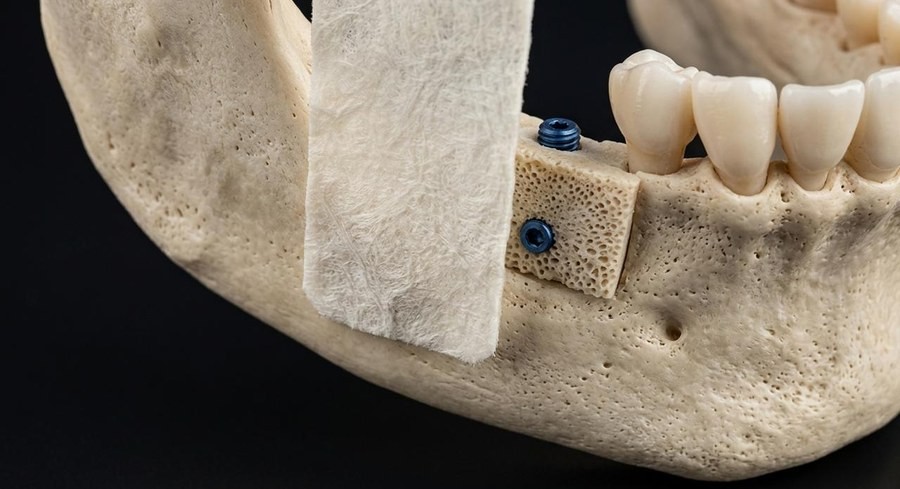

RMS foundation
Mechanical testing institute, Bettlach, Switzerland..
RMS foundation
Independent bench test carried out in Bettlach, Switzerland.

Module 02 · Precision Engineering
Bicortical locking with micrometric fit. An architecture designed to restrain all six degrees of freedom without transferring compressive stress to the crestal bone.
ISO H7/h6 Fit
Grade 2 Anodized Titanium
6 Degrees of Freedom
Bicortical Fixation
Cold-Welding Mitigation
PCT Applications Filed
Atraumatic Reversibility
RMS Bench Testing (Switzerland)
Engineering & Validation
Conical seat coupling with active preload, via an apical channel machined to ISO H7/h6 tolerance.
An apical channel, machined to ISO H7/h6 tolerance, houses the grade-2 anodized titanium transverse screw, which anchors bicortically. The conical seat generates preload through geometric interference, including an additional directional preload effect during coupling — a design objective whose quantification is pending a specific mechanical test.
Grade-2 anodized titanium, intended to mitigate the risk of cold welding between titanium components and fretting corrosion, with a surface designed to facilitate atraumatic elective removal.
RMS Foundation (Bettlach, Switzerland) — static cantilever load test on a standardized polymer model (E ≈ 5 GPa), in a controlled comparative test. Dynamic cyclic fatigue testing per ISO 14801, currently in the design phase.
Mechanical testing institute, Bettlach, Switzerland..
Future development
The transverse-screw architecture contemplates, from the original PCT filing, a biodegradable-alloy variant — contemplated within the architecture of the intellectual property applications filed, not an already-granted technology. The buyer acquires a platform with a defined scalability path, not a standalone product.
Instrumentation
Current validation protocol
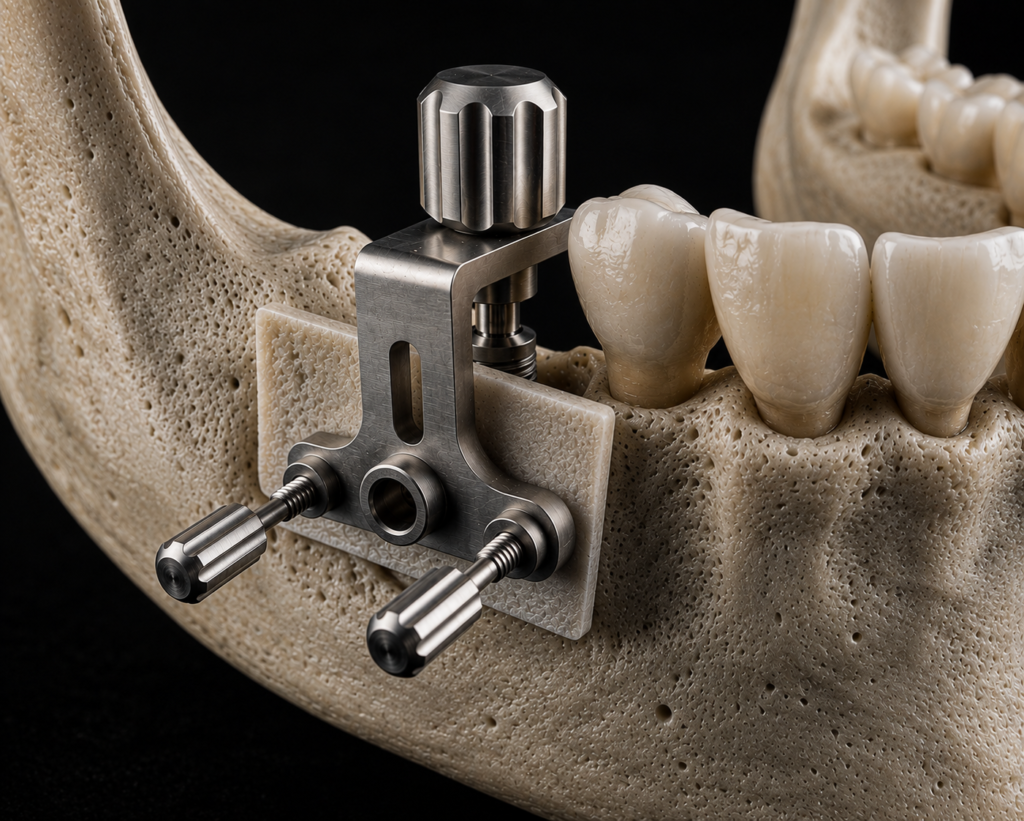
Conventional transverse drilling guide
An indexed instrument that constrains the trajectory and depth of the transverse osteotomy; it is the tool used in the mechanical tests and in the GLP preclinical protocol, chosen to keep the study simple and repeatable.
Second IP layer · in development
Unified surgical guide
Integrates, in a single CBCT-indexed body, the axial insertion sleeve, supracrestal alignment confirmation, and the oblique transverse channel, with simultaneous bone-graft stabilization built into the design. It is not part of the initial GLP protocol.
Bench results
Conditions: Zwicki Z5.0 machine · 2.5 KN load cell · test speed of 1.5 mm/min · Bettlach, Switzerland.
0.542 mm
0.296 mm
Independent bench test carried out in Bettlach, Switzerland.
Methodological note: assessment of static stiffness under critical cantilever conditions. For the next preclinical phase, dynamic cyclic fatigue testing per ISO 14801 is planned.
Do you have any questions?
Would you like to arrange a meeting?
Please fill in the form below and we’ll get in touch with you.